 EN
EN

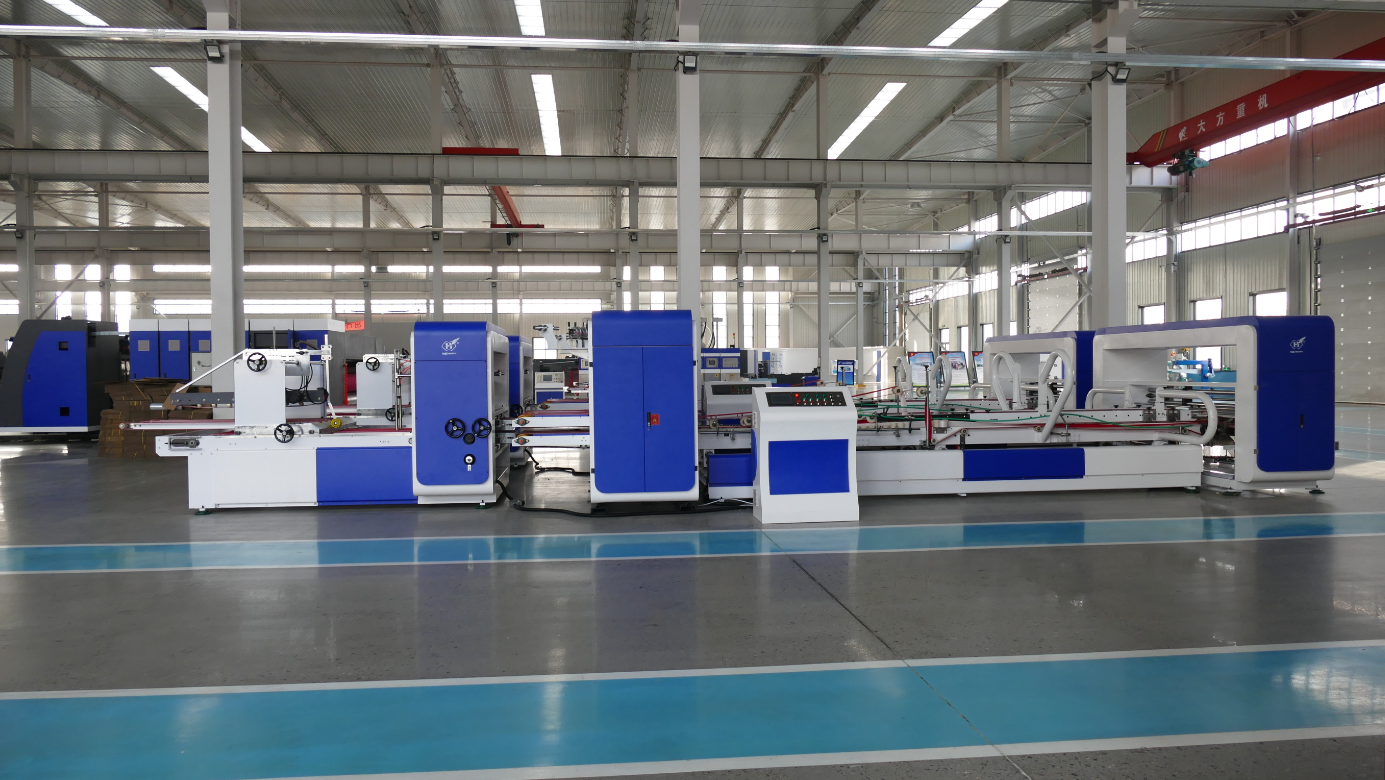
When you visit a carton factory and see an automatic folder gluer production line operating without a hitch it can be easy to think of it as a single"super machine."Yet one machine does not make a production line efficient. Automating a production line requires coordinated and efficient interacting"sub-systems."Each of these"sub-systems"performs a specific function and if one system does not meet expectations the entire production line will slow. What are these"sub-systems"that make an automatic folder gluer production line efficient? The answer is best illustrated by examples that contribute to a carton manufacturer's operations.
Precision Conveyor Systems
The conveyor system is the"backbone"of an automatic folder gluer production line. The conveyor system deliver carton blanks from the start to each stage of the production process and finally to the finished product stack. But not just any conveyor will do. Being high precision is a necessity to keep everything on track.
First, it must adjust to diverse carton sizes and materials without slipping and jamming. Consider a factory that produces small cosmetic boxes made of thin cardstock, and large shipping boxes made of thick corrugated. The conveyor requires varied speed settings—slower for fragile little blanks to prevent damage and faster for large, sturdy blanks to maintain production pace. It also requires anti-slip surfaces or soft pressure rollers to hold blanks securely to prevent shifting during movement. If a blank shifts during movement, the folding or gluing step will be misaligned and result in waste.
Another essential feature is the consistency of the conveyor with other components. It has to align with the speed of the folding mechanism and the timing of the gluing system. For instance, the conveyor moving too quickly causes the folding arm to seat the blank incorrectly, while too slow causes a buildup in the line. The best quality conveyors come with sensors that detect jams and automatically halt the conveyor if a blank is stuck, protecting other parts and reducing downtime. A precise, reliable conveyor is crucial to the overall performance of the system, with or without high quality folding or gluing parts.
Smart Control Systems
In the automatic folder gluer production line, if the conveyor is the backbone, the smart control system is the"brain."It's what turns a bunch of separate parts into a coordinated system, and it's crucial for efficiency and ease of use.
More modern control systems utilize intuitive touch screens, meaning operators don't have to be computer whizzes to make changes. For instance, if a factory is switching production from a 10cm-wide box to a 15cm-wide box, the operator just needs to pull up a saved program for the 15cm box, and there's no need to adjust every piece manually. In a matter of seconds, the control system balances the conveyor speed, folding arm positions, and gluing amounts. This is a huge time saver compared to manual setups, which can take 30 minutes or longer for a changeover.
The system has the ability to perform remote monitoring and fault diagnosis. Control panels tell the operators what the problem is when a line stops. This is much better than operators needing to guess the issue. Advanced systems permit transited remote repair fault monitoring that can ease repair of minor problems without the need to be on location. For factories with the tightest deadlines, every minute is important. This system saves time. The control system saves production, value and waste control data which helps managers identify waste and inefficiencies. Spot and fix waste and inefficiencies? Best leave that to the line's "brain". Without this "brain" control system the line would be slow, prone to errors and poorly managed.
Automatic Detection and Rejection Device
Defection and waste control is critical, especially to the automatic folder gluer production line's efficient workflow. The automatic detection and rejection device identifies problems before they reach customers. It is the "quality guard" of the line.
Most detection devices incorporate high-speed cameras and sensors to confirm if any errors exist on the boxes. Cameras detect boxes for misfolded edges, uneven glue application, and missing glue flaps. In addition, sensors detect any problems the camera might overlook, such as weak seams caused by insufficient glue, or a small blank that would render a box useless. For instance, a camera would detect a small cosmetic box where one fold is off by 2mm, which is difficult for a human to detect, but would render the box unprofessional.
Once a box detected as faulty is identified, the small air jet or mechanical arm, which is called the rejection device, triggers. This is a gentle way of pushing the faulty box off the line into a designated bin. In this way, only perfect boxes reach the finished stack. This guarantees that customers do not get defective products. It also reduces waste, but not directly. If faulty boxes were left unattended and returned, the waste generated would be more than just discarding them and customers would be more angry. Some systems even capture faulty detection and learn over it to improve their detection systems. In the absence of this guard, a factory would have to slow down the line and increase costs by hiring more workers to check each box scanned manually.
Efficient Gluing and Folding Mechanism
The glue and fold mechanisms are central to the entire automatic folder gluer production line as this is how the flat carton blanks are turned into boxes. The line's output and quality are determined by how efficiently and precisely these pieces work together.
With respect to the gluing mechanism, it is important to apply the correct amount of glue in just the right places. If there is an excessive amount of glue, there will be gluing drips which not only damage the boxes but also create messes. If there is too little glue, seams are weak and the box can easily fall apart. Modern gluing systems use precision nozzles or volumetric pumps which dispense glue in set amounts, even when the line is running at top speed. They can also change glue types, for example, water-based and hot-melt. Hot-melt glue needs to be heated to a certain temperature to work. The gluing mechanism has a built-in heater that maintains the ideal temperature, ensuring it works every time.
The folding mechanism also needs to be very precise and flexible. It has adjustable arms or rollers that create clean and straight folds along pre-scored lines. For different box styles like tuck-top or snap-lock, the folding components reposition quickly because of the folding mechanism's smart control system. It also needs to deal with material of different thicknesses. Folding thin cardstock requires gentle pressure, otherwise it will be overly creased, and thick corrugated material will need more pressure. Folds need to be sharp. The best folding mechanisms are made with high-quality and wear-resistant materials like hardened steel. Repairs will be infrequent. If the gluing or folding mechanism has an error, even one millimeter, the box is completely useless. The folding and gluing mechanisms are essential and must be precise.
Conclusion
An efficient automatic folder glue production line is not about one"star"component. It is about the harmony of four key components: a high-precision conveyor to keep the blanks moving, an intelligent control system to coordinate the different components, an automatic detection device to ensure quality at the end of the production line, and a reliable gluing/folding mechanism to produce perfect boxes. Each revolves around a specific problem: slipping blanks, and slow change-overs, faulty cut boxes, and messy glue. Working together these components transform a basic production line and make it fast, consistent, and cost-effective.
For box-making companies, prioritizing these parts translates to having less waste, less downtime, and having happy customers. These pieces fit to give you the flexibility to produce these parts, and allow you to maintain your production during high-demand seasons, whether you are producing small cosmetic boxes or large shipping containers. At the end of the day, the best automatic folder gluer production line is the one where you hardly pay attention to the various components and simply enjoy the seamless flow of perfectly packed boxes.