 EN
EN

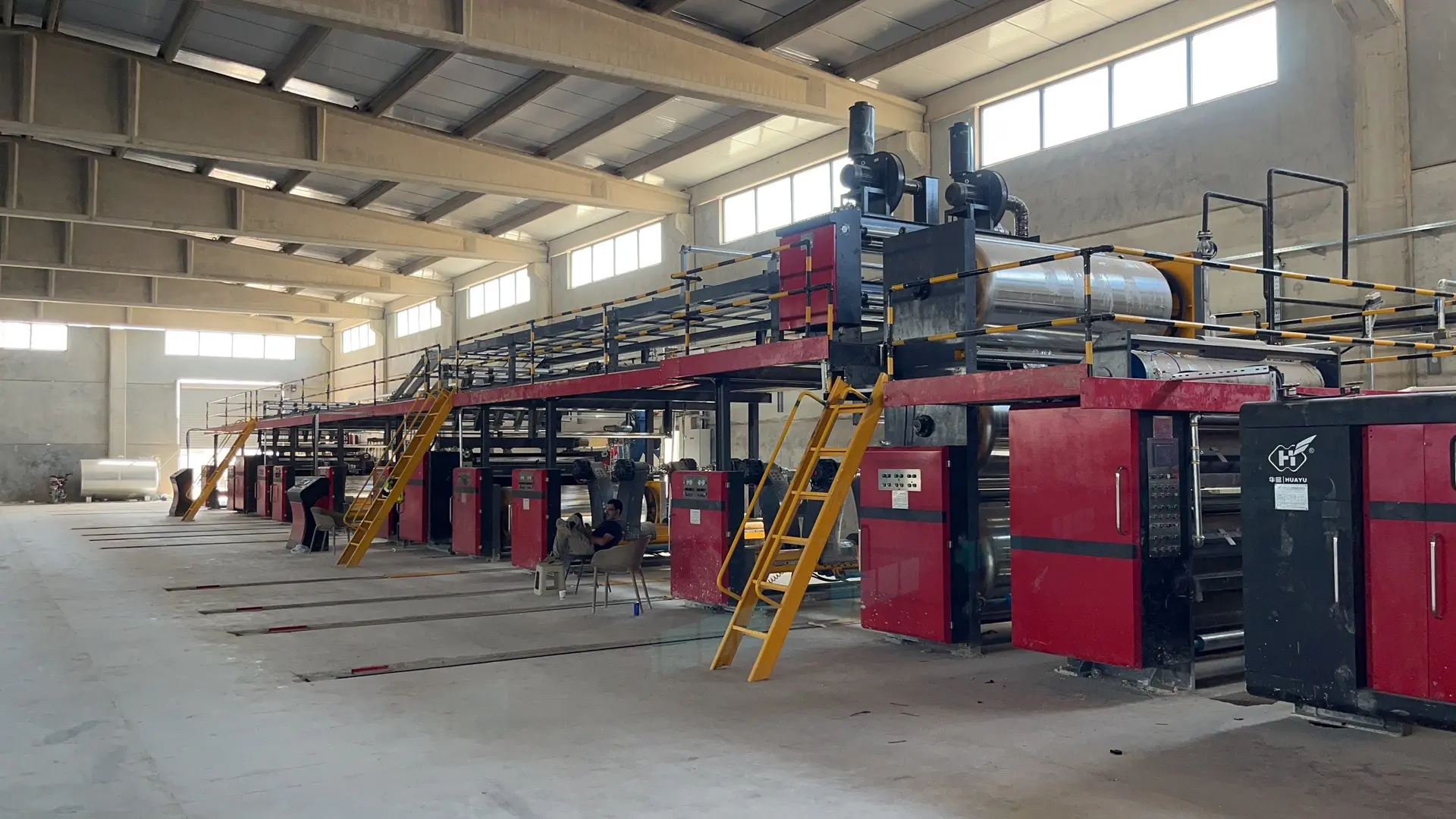
Understanding the Corrugated Carton Box Production Workflow
Overview of the corrugated box manufacturing process step by step
A modern corrugated carton box production line transforms raw paper rolls into protective packaging through five critical stages: fluting, lamination, drying, cutting, and assembly. This streamlined workflow ensures precise material utilization while maintaining structural integrity, with top-performing lines processing over 1,200 linear meters of board per hour (Packaging Trends 2023).
Creating the corrugated medium (fluting process) and board formation
The fluting process heats kraft paper to 177°C in corrugating rolls, forming the wave pattern that provides 40% of a box’s compressive strength. Adhesive is applied with precision, its viscosity maintained between 12–18 seconds (Ford Cup #4), ensuring optimal bonding without oversaturation.
Forming single-wall, double-wall, and triple-wall corrugated board
- Single-wall: One fluted layer between linerboards (B-flute: 3mm, ideal for retail packaging)
- Double-wall: Two fluted mediums (BC-flute: 6mm, suited for industrial use)
- Triple-wall: Three corrugated layers (EB-flute: 10mm, used for heavy machinery)
Board type influences production speed—triple-wall configurations require conveyor speeds 22% slower than single-wall setups due to increased thickness and bonding complexity.
Drying and cutting corrugated board for downstream processing
Drying tunnels use infrared sensors and variable heat zones (80–110°C) to maintain board moisture at 12–15%. Rotary die-cutters then shape blanks with ±0.5mm accuracy, achieving scrap rates below 3.8% in optimized systems.
Folding, gluing, and final shaping in automated packaging lines
High-speed folder-gluers produce up to 450 boxes per minute using computer-guided suction feed systems. Hot-melt adhesives applied at 180–200°C achieve 90% bond strength within 8 seconds, enabling immediate stacking and reducing handling delays.
Core Machinery in a Corrugated Carton Box Production Line
Key equipment from roll stand to stacker in corrugated production
Modern production lines integrate 8–12 specialized machines into a continuous system. The workflow begins with motorized roll stands unwinding kraft paper at speeds up to 400 meters/minute, feeding corrugators, slitters, die-cutters, and automated stackers that organize finished boxes into pallet-ready units.
Corrugators and single-facer units for fluted board creation
The single-facer unit forms the flute profile using heated steel rolls (150–180°C), shaping medium-grade paper into A, B, or C-flute patterns. Starch-based adhesive bonds the fluted medium to the first linerboard, with advanced systems maintaining ±1°C temperature control for consistent geometry across runs.
Double-backer systems and hot plates for bonding layers
In multi-wall production, double-backer units apply secondary liners under heat (170–190°C) and pressure (50–100 psi). For triple-wall boards, multiple pressure zones prevent delamination. Closed-loop adhesive systems ensure bond strengths exceed 40 lbf/in², meeting ASTM D903 standards.
Integrated cutting, creasing, and printing units for finishing
Rotary die-cutters perform blank separation and creasing in one pass, achieving ±0.8mm tolerances. Flexographic printers apply water-based inks at up to 150 LPI resolution, while inline vision systems conduct defect checks every 200ms. These integrated units reduce material waste by 12–18% compared to batch methods.
Automation and Smart Technology for Peak Line Efficiency
Current automation benchmarks in corrugated carton box production
Top-tier lines achieve over 85% operational efficiency through servo-driven synchronization. Automated single-facer units adjust flute profiles in real time based on incoming paper moisture, supporting production speeds exceeding 300 linear meters per minute.
IoT and AI integration for real-time monitoring and control
AI-driven platforms analyze over 15 variables—including adhesive viscosity and roll-stand tension—via IoT-enabled sensor arrays. According to 2024 industry benchmarks, this predictive approach reduces warp defects by 22% and cuts energy consumption by 18% compared to manual operations.
Robotic stacking and palletizing to reduce labor and increase speed
Six-axis robotic arms handle 1.2-ton loads with 0.5mm placement accuracy, completing stacks in under 8 seconds. Integrated with warehouse management systems, automated guided vehicles (AGVs) maintain buffer inventory below 2%, optimizing flow during peak output.
Maximizing Production Capacity and Minimizing Downtime
Measuring and Optimizing Output in High-Speed Corrugated Lines
Real-time monitoring systems track uptime, changeover times (typically 8–12 minutes), and hourly output against theoretical capacity. Leading facilities leverage IoT dashboards to assess performance, with top producers achieving 92–96% Overall Equipment Effectiveness (OEE) through AI-driven adjustments.
Balancing Line Speed with Material Flow and Waste Reduction
Efficient lines synchronize key parameters:
- Flute paper unwinding (100–450 m/min)
- Adhesive application (12–18 g/m²)
- Cutting cycle timing
Predictive algorithms adjust conveyor speeds based on laser-scanned board thickness, reducing trim waste by 23% and sustaining 93–97% material efficiency.
Material Selection, Quality Control, and Industry Compliance
Calibrating Tools Based on Corrugated Board Thickness and Type
Misaligned tools are responsible for around 23% of all downtime on these fast-moving production lines. When working with 0.25-inch single-face boards, getting those slotting knives just right matters a lot. They need to stay within plus or minus 0.001 inches alignment tolerance, otherwise, we end up with failed glue joints. Most modern die cutters now come equipped with fancy piezoelectric sensors that automatically adjust the pressure between 1.5 and 4.5 psi, depending on how dense the board material is. Speaking of improvements, recent research from the 2024 Corrugation Process Study shows something pretty impressive too. Their findings indicate that when using AI-guided calibration systems, setup errors drop by about 34% specifically for those lighter duty boards under 90 grams per square meter. That's a significant improvement for manufacturers dealing with these materials regularly.
Quality Inspection Systems and Feedback Loops in Production
Inline optical scanners detect defects at 160 ft/min with 99.7% accuracy, identifying issues like delamination or ink misregistration. Data from 9-axis sensors feed predictive models that automatically adjust steam levels (285–310°F) and starch viscosity (30–45 cP), improving compression strength by 15–22% across mixed-material batches.
Meeting Industry Standards: Burst Test, Edge Crush Test, and Safety Compliance
All corrugated boxes must meet ISO 3037 requirements:
| Test | Single-Wall Requirement | Triple-Wall Requirement |
|---|---|---|
| Burst Strength | ≥175 kPa | ≥625 kPa |
| Edge Crush | ≥7 kN/m | ≥40 kN/m |
| Cobb Water Absorb | ≤160 g/m² (30 min) | ≤80 g/m² (30 min) |
Automated test stations validate 100% of production output, generating digital compliance certificates for seamless supply chain traceability.
FAQ
What are the main stages in the corrugated carton box production process?
The main stages include fluting, lamination, drying, cutting, and assembly.
How does the fluting process contribute to the box's strength?
The fluting creates a wave pattern that provides 40% of the box’s compressive strength.
What types of corrugated boards are typically produced?
Single-wall, double-wall, and triple-wall boards are commonly produced, each suited for different applications.
Table of Contents
-
Understanding the Corrugated Carton Box Production Workflow
- Overview of the corrugated box manufacturing process step by step
- Creating the corrugated medium (fluting process) and board formation
- Forming single-wall, double-wall, and triple-wall corrugated board
- Drying and cutting corrugated board for downstream processing
- Folding, gluing, and final shaping in automated packaging lines
- Core Machinery in a Corrugated Carton Box Production Line
- Automation and Smart Technology for Peak Line Efficiency
- Maximizing Production Capacity and Minimizing Downtime
- Material Selection, Quality Control, and Industry Compliance
- FAQ