 EN
EN
What makes a supplier “reliable”
A reliable supplier is more than just someone who sells machines. Key qualities include:
-
Experience & reputation: Years in business, positive customer feedback, case studies, references.
-
Technical capability: R&D strength, ability to deliver machines with stable, high performance.
-
Certifications & quality control: Things like ISO standards, CE, or other local/international certifications.
-
After-sales service: Installation, training, spare parts, maintenance support.
-
Customizability & flexibility: Can the supplier adjust to your product specifications (flute type, speed, width, ply count)?
What Huayu Carton Machinery offers (as a good example)
Let’s use Dongguang Huayu Carton Machinery Co., Ltd. as a case study of a supplier who meets many “reliability” criteria. From their product pages:
-
They produce corrugated board production lines with multiple flutes (3/5/7 ply), high speeds, and large widths.
-
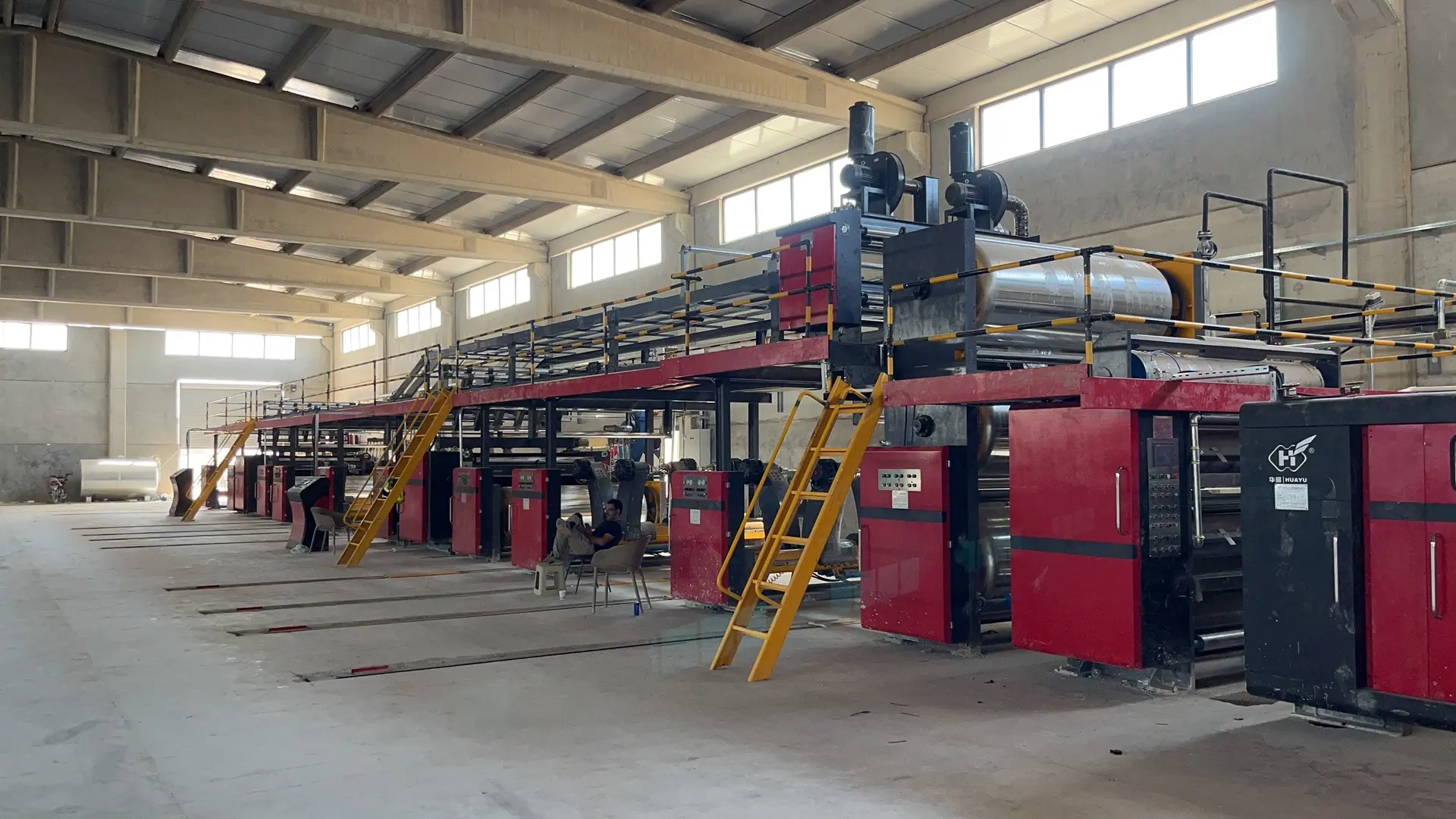
Their “HYM Series Intelligent High-speed Corrugated Cardboard Production Line” is a complete line: including shaftless mill roll stand, fingerless single facer (vacuum suction type), pre-heater, gluer machine, double facer, slitter scorer, stacker, glue making system.
-
They emphasize features like high automation, easy operation & maintenance, good paperboard quality, compact structure, and appearance.
-
They have quality management: ISO9001:2015, EU CE certification.
-
Their product specification data is relatively detailed: speed ranges, width, cutting/slitting precisions, etc.
Steps to selecting a reliable supplier
When selecting a corrugated cardboard production line supplier, the first step is to clearly define your own requirements. Consider how many plies you need—3, 5, or 7—what flute types you plan to produce, the production speed, and the daily or weekly output you expect. With these details in hand, you can compare suppliers more effectively.
Next, review the technical specifications carefully. Look at maximum operating speed, working width, precision of cutting and slitting, and the level of automation. These details will directly affect efficiency, waste, and long-term reliability.
It is also important to evaluate the supplier’s manufacturing standards and quality control processes. Certifications such as ISO or CE can serve as indicators of consistency and international compliance. Whenever possible, request a factory tour or technical documents to confirm that production standards are being followed.
After-sales support is another critical factor. A reliable supplier should provide a reasonable warranty, quick access to spare parts, and services like installation and operator training. These elements significantly reduce downtime and ensure that your investment keeps performing over time.
In addition, ask for demonstrations, videos, or customer references. Speaking to existing users or seeing machines in action can give you a realistic picture of performance and reliability. Finally, don’t make decisions based solely on the initial purchase price. Calculate the total cost of ownership, including shipping, installation, energy consumption, maintenance, and potential downtime. A supplier offering flexibility and scalability—such as the ability to switch between different flute types or upgrade capacity later—will help you adapt to changing market demands.
How Huayu meets these selection criteria
Using the above steps, here’s how Huayu aligns:
-
Clear specs: Huayu provides data for line components like single facer, slitter scorer, etc.
-
Certifications: Huayu holds ISO9001:2015, EU CE.
-
After-sales support: They claim to provide tech support, spare parts, installation assistance.
-
Flexibility: Their lines can produce 3/5/7-ply, multiple widths, various speeds.
So for many purchasers, Huayu would score highly in reliability.
Common pitfalls to avoid
-
Overly low price with vague specs may hide lower quality parts or missing services.
-
Suppliers who don’t provide clear documentation or warranties.
-
Poor communications or lack of transparency about lead times or spare parts.
-
Ignoring indirect costs (installation, operator training, utilities, downtime).
Conclusion
In summary, when you ask: How to select a reliable corrugated cardboard production line supplier? you should focus on:
-
getting precise technical specs aligned with your needs,
-
supplier’s experience and quality systems,
-
thorough after-sales support,
-
transparency in pricing and cost of ownership,
-
ability to scale and adapt.
Using Huayu as an example, they illustrate many of the “must-have” qualities: certifications, full-line capability, detailed specs, support, etc. If a supplier lacks these, proceed cautiously.
Frequently Asked Questions
Q1: How important is it to visit the supplier’s factory or see customer references?
A1: Very important. Seeing the factory gives insight into build quality, cleanliness, how well processes are controlled, and whether the supplier is capable of delivering what they promise. Talking to existing customers helps you learn real-world reliability, durability, and service.
Q2: What level of automation should I ask for in a production line?
A2: That depends on your production volume, labor cost, and how consistently you need output. For medium or large scale production, high automation (PLC control, automated glue mixing, slitting, stacking) reduces errors, labor, and downtime. For small scale, semi-automatic may suffice.
Q3: How do I estimate the total cost of ownership (TCO)?
A3: Add up the purchase price + shipping + installation + operator training + spare parts + electricity, glue, paper waste + downtime due to maintenance. Also consider resale or upgrade costs. Compare this across multiple suppliers—not just sticker price.