 EN
EN
For every minute of downtime on the corrugated carton production line, a carton manufacturing business loses profit. In addition to missing order deadlines, slow production increases labor costs and wastes materials. Fortunately, optimizing production lines for speed does not require a business to tear down and rebuild. With the right equipment, workflow streamlining, and attention to small inefficiencies, businesses can help improve production lines. With decades of experience on carton machinery, HUAYU and similar businesses in the industry have developed solutions to tackle speed bottlenecks directly. This article outlines the best methods to improve speed on a corrugated carton production line while maintaining quality.
Invest In and Upgrade High-Performance Core Equipment
To achieve a fast corrugated carton production line, businesses must invest in quality, purpose-built equipment. One of the biggest causes of slow line production is the use of out-of-date and incompatible equipment. These machines are unable to fully meet demand, tend to break down frequently, and require excessive manual adjustments. This equipment also increases the speed loss of the production line.
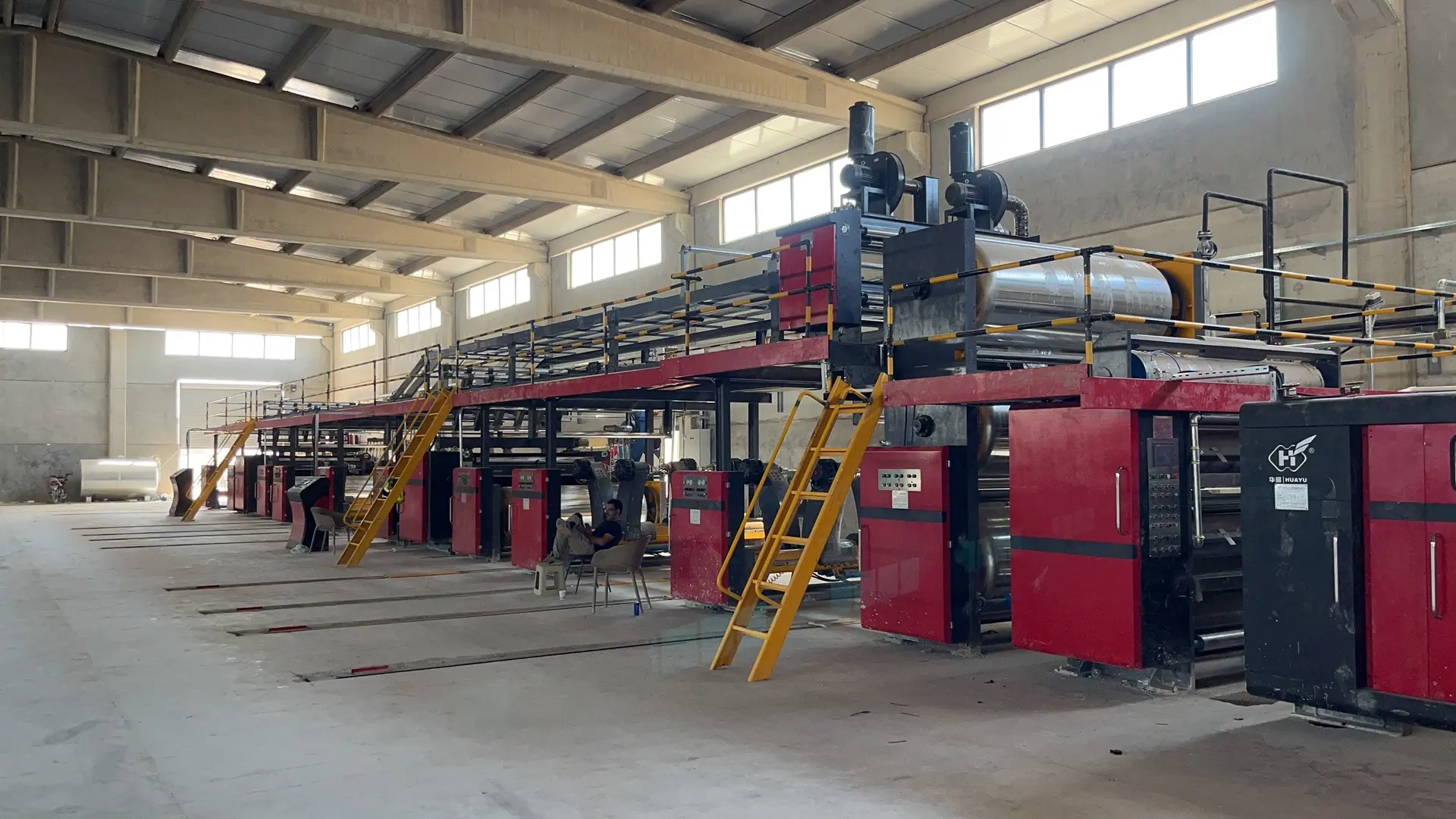
Let’s start with the centerpiece of the operation. For example, the HUAYU WJ Series high-speed production line is the most advanced system in the industry. It is equipped with advanced tracking systems to ensure the board remains trouble-free. This is essential to avoid disruptions to the flow of production caused by board jams. Older systems require operators to adjust the tension and fix structural alignment, but this series is engineered with auto-detect capabilities to fix problems like uneven paper.
Also look at the most advanced postproduction equipment, the printing and gluing systems. The game-changing HUAYU HS-A Series fully computerized high-speed printing gluing with auto-bundle machine and integrated system controls gave unprecedented flexibility in job setup and printing with guaranteed consistent quality every run. The auto-bundle system guarantees that operators are no longer required to restack and bundle fully finished cartons, preventing bottlenecks in the flow of the production line.
Every upgrade counts. For example, moving to a HUAYU HS Series fully vacuum transfer printing slotting die-cutting machine (with vacuum transfer top printing) replaces slow, imprecise manual feeding of the materials. Because of the vacuum system, the board is held firmly and moves faster through the printing and die-cutting processes, which eliminates shifting and reduces misprints and the need to rework. Increased speed is achieved. When selecting equipment, consider features such as computerized controls, auto-detection, and system integration with other line parts. These ensure that all line components do not work in discord.
Organize and Simplify the Work Process to Get Rid of Bottlenecks
Even the fastest individual machines will slow down if your workflow is disorganized. Bottlenecks—those spots where materials pile up or production pauses—are primarily found in the movement of the materials, the job setup, and the order switching. Streamlining these processes, will help your corrugated carton production line maintain a consistent speed.
Start off by mapping out your workflow to identify any problem areas. The most common trouble spots are the handoff between the production of the corrugated boards and the printing, and the time it takes to change from one carton design to another. For example, if your team works manually to carry stacks of boards to the printing machine, that becomes a bottleneck. HUAYU integrates corrugated production and printing to seamless machine connections. This simple idea can save 10 to 15 minutes of production time every hour. That adds to several hours of extra production time the facility can use every week.
Job setup in printing and production line is another important bottleneck. Traditional lines require each operator to manually reset machine controls, which can take 20 to 30 minutes during order switching. Fully computerised secto machines, like HUAYU HS-A Series, automate the entire setup saving tremendous time and effort. For businesses that handle starting and stopping inputs frequently, that means they can switch between different carton sizes and designs without long pauses. This makes a difference when multiple small orders are in play. The line will make a pronounced speed increase on small orders that would have required long pauses.
Another crucial aspect is the efficient management of materials. Positioning raw materials like paper rolls near the production line, and scheduling finished cartons for shipping close to the bundling machine, minimizes time lost in the movement of goods. Automating bundling with HUAYU equipment further streamlines the process as it quickly and efficiently prepares carton bundles for shipping. When there are no gaps or manual handoffs between steps in the process, the entire production line operates at optimal efficiency.
Integrate Proactive Maintenance to Prevent Unplanned Downtime
There is no question that unplanned downtime is the biggest threat to speed. An idle production line for corrugated cartons can mean broken machines and lost time. It is more efficient to put in place a maintenance schedule that addresses potential breakdowns rather than waiting for them to happen.
To begin, regular inspections on key components should be performed. With high-speed lines from HUAYU, like the WJ Series, the wear parts need to be checked every couple of weeks. Maintenance schedules provided by manufacturers should be followed. This way, you will avoid waiting for parts to fail. For instance, if you replace a worn out conveyor belt before it breaks, you will avoid a 2-hour shutdown to fix it. HUAYU gives detailed instructions so it is easy to plan maintenance for all of their machines.
The inclusion of remote maintenance functionality greatly improves the speed of maintenance. Several of HUAYU’s machines, for example the HS-A Series, have remote maintenance functionality, meaning that technicians can diagnose the problem and fix certain issues without coming to your facility. This is a significant time saver as remote maintenance greatly reduces the time it takes to make repairs. For example, when a sensor breaks, a technician can troubleshoot the problem from their office and guide your team out of a fix in 30 minutes. This is a drastically quicker repair time than waiting a day for the technician to come for an on-site repair.
Investing in quality components can also lead to a reduction in downtime. While inexpensive, generic parts can save costs initially, they tend to malfunction more frequently. Huayu cuts components (parts made with CNC processing machines and CNC drilling equipment) that last. They are ISO 9001 and CE compliant, which means you do not have to replace those components often. Take, for example, a die-cutting blade. A Huayu blade can last 3 months, while a generic blade lasts a mere 1 month. The less you replace a blade, the less downtime you have to spend on the machine.
You can also avoid lengthy downtimes by keeping a few critical spare parts (like sensors or belts) and replacing them right away when a machine part fails. This can transform a 4-hour machine shut down into a 15 minute shut down.
Train Operators for Efficient Operation
Well equipped and properly defined workflows can still not achieve optimum performance speeds without trained operators. A trained operator can detect and fix potential problems before they escalate, deploy machine capabilities to fast track production, and eliminate errors that cause production lags. Optimization speed through operator training is one of the most valuable investments.
To maximize the efficiency of your machines, the first step is training operators. Because HUAYU features advanced, fully computerized machines, some operators might not fully utilize advanced features like auto-detection or digital job storage. For instance, an operator trained to use the auto-detect functionality for fixing paper-feed issues will take roughly 2 minutes compared to an untrained operator who might squander 15 minutes troubleshooting. With this in mind, HUAYU contributes to training since instruction will pay for itself within the first month due to fast and increased production.
Operations training should also emphasize the identification of bottlenecks and persistent inefficiencies. For example, trained employees recognize when output boards are accumulating at the printing machine and adjust the conveyor speed to eliminate the build-up, rather than do nothing and watch the pile grow. They are also skilled in rapid machine cleaning (without missing steps) and minor repairs (like replacing an old roller) which could prove invaluable while waiting for a technician to attend to the machine. All of these proactive behaviors and attitudes have a compounding and permanent effect on the production line.
Cross-training has its benefits. Having employees learn to operate different machines (like both the production line and the printing machine) lets you fill in empty spots during absences without affecting production. For example, if the printing machine operator is out sick, a cross-trained production line operator can step in, instead of stopping the entire line. HUAYU's machines have intuitive controls, streamlining the cross-training process since operators won't have to learn entirely different systems for each machine.
Increasing the efficiency of your corrugated carton production line isn’t simply about speeding things up; it’s about finding the potential to work smarter. Increasing production without sacrificing quality can be achieved through the selection of high-performance equipment designed for speed, the streamlining of workflows to remove bottlenecks, the keeping of machines in pristine condition, and the training of operators to work the equipment to the maximum of its potential. Companies like HUAYU invest decades to perfect their machines to solve these problems. Their machines contain features like computerized controls, auto-detect mechanisms, and even remote maintenance—all designed to support enhanced line speed. Whether you're managing a small line for customized orders or a large line that churns out thousands of cartons every hour, these steps are designed to help reap maximum speed, and profit, from your equipment. The outcome is a line that meets demand, delivers on time, and operates without a hitch, day after day.